Introduction
The K2 Base Camp trek is a challenging and awe-inspiring journey, offering trekkers a chance to experience one of the world’s most renowned and formidable mountain landscapes. Located in the Karakoram Range of northern Pakistan, K2 is the second-highest mountain in the world and presents unique challenges to those daring enough to trek to its base camp. Here's a complete guide to help you understand the difficulty, seasonality, and weather conditions you can expect on this trek.
1. K Base Camp Trek Difficulty Level
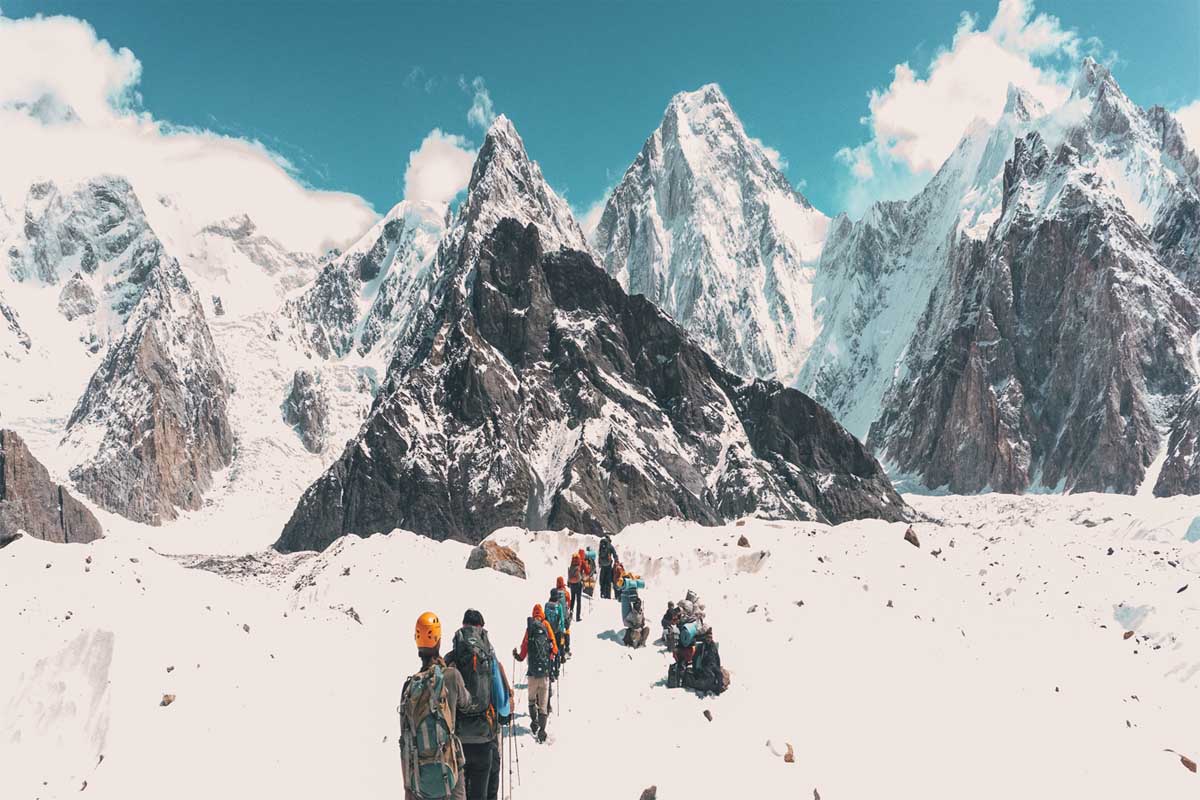
Trekking Towards K2 base camp, Gasherbrum Spire in the backdrop
The K2 Base Camp trek is considered a challenging to very challenging trek, primarily due to its remoteness, altitude, and demanding terrain. Here are the key factors contributing to the difficulty:
-
Altitude: The trek reaches an altitude of 5,150 meters (16,900 feet) at K2 Base Camp. Altitude sickness can be a risk, and trekkers must acclimatize properly to avoid complications such as headaches, dizziness, or nausea.
-
Length and Duration: The trek typically spans 12-14 days, covering around 90 km (56 miles) one-way. This is a lengthy and physically demanding journey, with significant elevation gain and loss.
-
Terrain: The route crosses rocky paths, glaciers, river crossings, and rough, uneven ground. The terrain can be tricky, requiring physical stamina and surefootedness.
-
Limited Facilities: Trekking to K2 Base Camp is not a luxury experience. You will be camping along the way, often in basic conditions. You’ll need to be prepared for cold nights and unpredictable weather.
-
Physical Fitness: A good level of fitness is crucial for the trek, especially since it involves long days of walking in rugged terrain at high altitudes. Trekkers should prepare with cardiovascular and strength training exercises, focusing on endurance.
You may like to read Daily distance and altitude on K2 Base Camp Trek.
2. Seasonality for Trekking K2 Base Camp
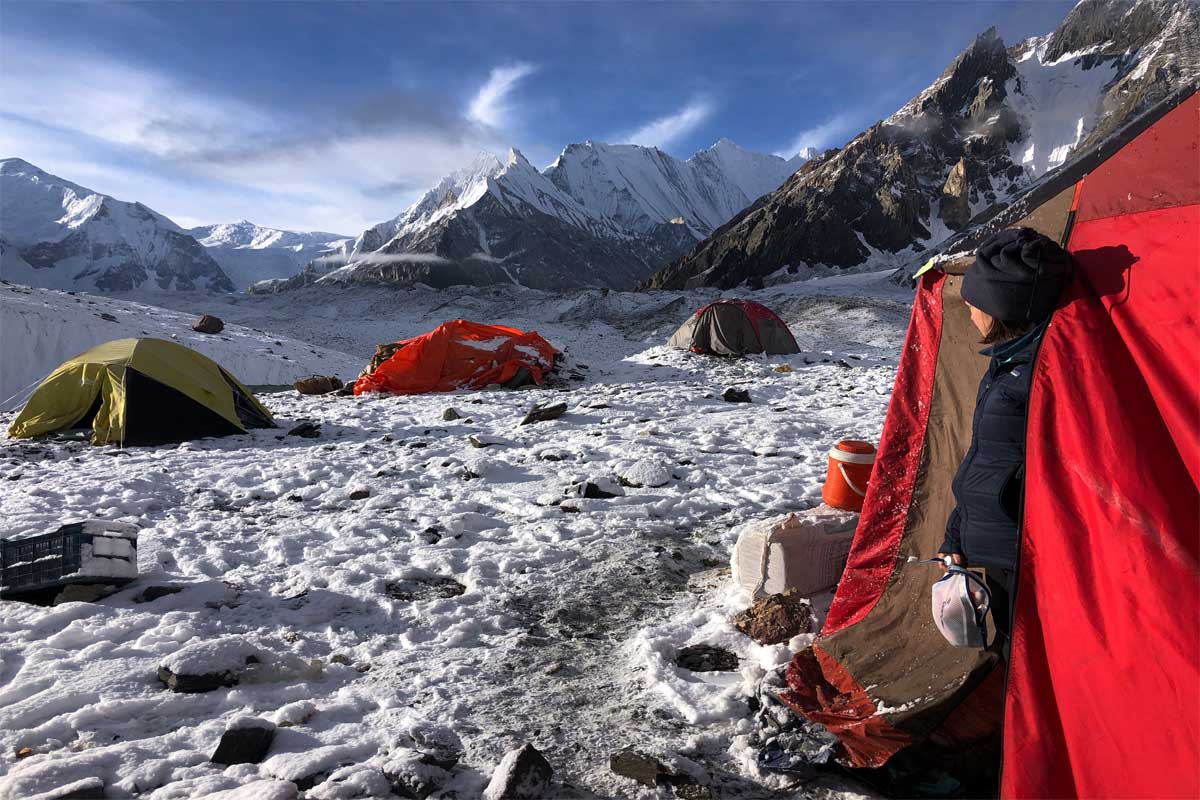
Snowfall at Concordia Camp in late August
The best time to trek to K2 Base Camp is during the summer months, specifically between late June to September. However, the seasonality of the trek can impact the conditions and the experience:
Peak Trekking Season (Late June to September)
-
Weather Conditions: This is the ideal time for the trek, as temperatures are relatively warmer and precipitation is lower. The Karakoram Range experiences clear skies, allowing trekkers to enjoy spectacular views of K2 and other surrounding peaks.
-
Crowds: Although this is the peak trekking season, it is still relatively quiet compared to more popular trekking destinations. However, it is advisable to book in advance as spaces in the limited campsites fill up.
-
Safety and Accessibility: Trails are accessible, and the chances of avalanches or extreme weather are lower, making it the safest time for the trek.
Pre-season (Late May to Early June)
-
Weather Conditions: Weather can be variable, with lingering snow and the possibility of storms. It’s a quieter time for trekking but also less predictable.
-
Challenges: Some routes may still be blocked by snow or ice, and it may take longer for campsites and facilities to be fully set up.
Post-season (Late September to November)
-
Weather Conditions: The weather starts cooling down, and it may get chilly, especially at higher altitudes. While there are fewer trekkers during this time, the weather can be unpredictable with an increased risk of snowstorms.
-
Accessibility: It’s still possible to trek, but the conditions can be harsher, and some services may be reduced as the season winds down.
Best Time for Gondogoro La 5600m Crossing:

View of K1 8611m from Gondogoro La Summit 5600m
The best time for Gondogoro La (5,600m) is during the short and sensitive summer weather window, because this high mountain pass is far more weather-dependent than the classic K2 Base Camp trek. In general, Gondogoro La is only realistically doable from mid-June to mid-September, when the snow conditions are stable enough and the route is accessible for fixed ropes and safe crossing. However, even in this period, the pass remains fully contingent on weather, fresh snowfall, wind, and visibility, and can close temporarily even during peak season.
Among all months, July and August are considered the prime time for crossing, offering the best combination of stable weather, warmer nights, and a higher success rate. That’s why, if you are keen to cross Gondogoro La, planning your trek in July or August gives you the strongest chance of a safe and successful summit-day crossing.
Read more about Gondogoro la in the link Gondogoro La Difficulty
3. Weather Conditions
 On the way to Concordia
The weather on the K2 Base Camp trek can vary significantly due to the trek’s high altitude and remote location. Here’s an overview of the typical weather conditions:
Summer (June to September)
-
Temperatures: At lower altitudes (2,000m-3,000m), daytime temperatures range from 10°C to 20°C (50°F to 68°F), while at higher altitudes, temperatures drop to around 0°C to -10°C (32°F to 14°F) during the night.
-
Weather: During summer, the weather is generally dry, with clear skies and little rainfall. However, storms and heavy winds can occur, especially at higher altitudes.
-
Snowfall: Snow is generally rare during the trekking season, though light snowfall can occur at higher elevations.
Winter (November to March)
-
Temperatures: Winter temperatures drop significantly. Daytime temperatures at base camp can be as low as -20°C (-4°F), and nighttime temperatures can plummet even further.
-
Weather: The Karakoram Range experiences heavy snowfall, blizzards, and extreme cold. Winter is an unsafe time for trekking due to the cold and risk of avalanches, as well as the complete lack of trekking facilities and services.
-
Challenges: Apart from the freezing temperatures, the risk of frostbite, snowstorms, and treacherous conditions on the trail makes winter months unsuitable for the trek.
Spring (April to May)
-
Temperatures: Spring sees milder temperatures than winter, but conditions can still be quite cold, especially at higher altitudes.
-
Weather: Spring weather is variable, with some rain and possible snowstorms, but it is generally less severe than winter. This is a transition period, with some areas still covered in snow.
-
Challenges: Spring trekking can be a bit unpredictable, and there might still be some difficulty navigating snow-covered paths.
How K2 Base Camp Trek Compares to Everest Base Camp and Kilimanjaro

K2/Chogori Base Camp 5120m
When comparing the K2 Base Camp Trek with Everest Base Camp (EBC) and Kilimanjaro, the biggest difference is the level of remoteness and overall difficulty. EBC is high and challenging, but it is supported by a well-developed trail network, frequent teahouses, and daily access to food, lodges, and emergency services. Kilimanjaro is physically demanding due to its rapid altitude gain, but it is a non-technical climb on a clear trekking route with a strong support system and a shorter duration. In contrast, the K2 Base Camp Trek is a true wilderness expedition where the difficulty is not just altitude, it’s the terrain, isolation, and long trekking days that make it significantly tougher for most trekkers.
In terms of difficulty, K2 Base Camp is widely considered harder than both EBC and Kilimanjaro, especially for trekkers who are not used to rough mountain terrain. The trail in Baltoro is long, remote, and often involves walking on glaciers, loose rocks, moraine, and uneven surfaces for many consecutive days. There are no villages, no teahouses, and no easy exit routes, meaning your body must handle continuous trekking with limited comfort and recovery. Even strong hikers find the Baltoro Glacier demanding because it requires constant balance, endurance, and mental toughness. While Kilimanjaro is a higher summit and EBC is famous for altitude, K2 Base Camp stands out as the most rugged and expedition-style trek, making it the toughest of the three in overall trekking difficulty.
4. Preparing for the Trek

Physical Preparation
-
Cardio and Strength Training: Cardiovascular fitness and leg strength are key to handling the long, demanding days of the trek.
-
Altitude Training: If possible, acclimate to higher altitudes before undertaking the trek to reduce the risk of altitude sickness.
-
Packing: Pack lightweight, yet warm, clothing, a good pair of trekking boots, a sleeping bag suitable for freezing temperatures, and gear to protect against snow and wind.
Health and Safety
-
Acclimatization: Ascend slowly and take regular rest days to allow your body to adjust to the high altitude.
-
Hydration and Nutrition: Carry sufficient water and high-energy snacks. Hydration is crucial to avoid altitude sickness.
-
Guides and Porters: It is highly recommended to trek with a guide, especially for such a remote and challenging route. They can assist with navigation and provide local knowledge, improving both your safety and experience.
Conclusion
In conclusion, the K2 Base Camp Trek is not just a trek, t is a true expedition into one of the wildest and most dramatic mountain regions on Earth. With its long trekking days, rugged glacier terrain, and remote camping experience, it is widely considered more challenging than many famous treks such as Everest Base Camp or Kilimanjaro. The difficulty is not technical climbing, but the combination of altitude, endurance, and the harsh, untouched environment of the Karakoram, which demands strong physical fitness, mental resilience, and proper preparation.
Because the trekking season is short and weather can change suddenly, choosing the right time is essential for a successful journey. The best months are July and August, when conditions are generally more stable, while the overall trekking window usually runs from mid-June to mid-September. With careful planning, the right equipment, and expert local support, the K2 Base Camp Trek becomes a once-in-a-lifetime adventure, rewarding trekkers with unforgettable views of K2, Concordia, and the legendary giants of the Karakoram.
Chogori Adventure offers 12 confirmed fixed departures, private trekking options, and is one of the most trusted local companies for the K2 Base Camp Trek. Follow the link below to view full details, dates, prices, and the complete itinerary K2 BASE CAMP TREK.